
KY, UNITED STATES, January 15, 2026 / EINPresswire.com / -- Annual Threat Analysis: With AI-powered real-time face-swapping technology passing the Turing Test, WSJ reports on executive fraud are on the rise, signaling that the "Zero Trust" architecture is likely to extend from the network layer to the biological layer.
SQHWYD GLOBAL Ltd. Security Consultant and Halborn founder Gideon Cohen today issued the "Institutional Security Advisory 2026," codenamed "Phantom War." In response to recent extensive coverage by the Wall Street
Journal and CNBC about multinational corporations suffering massive losses due to "AI Face-Swapping Executives" scams, Cohen issued a stark warning: traditional video KYC and voice verification will become completely ineffective by 2026.The End of Identity: Seeing Is No Longer Believing.
The report meticulously analyzes a series of high-tech fraud cases that occurred between the end of 2025 and the beginning of 2026, the most famous being the case in which the Hong Kong branch of a multinational financial company was defrauded of US$250 million—the attackers used AI to generate a hyper-realistic CFO and several colleagues participating in a video conference, tricking the finance team into authorizing transfers. "In 2026, if you see your CEO on Zoom or Teams ordering you to transfer funds immediately, there's a 35% chance you're talking to an AI model," Cohen bluntly points out. "Social engineering against human senses has been industrialized. Any system that relies on 'individual authorization,' no matter how high-level the person, is an extremely fragile single point of failure."
MPC: Math Doesn't Lie
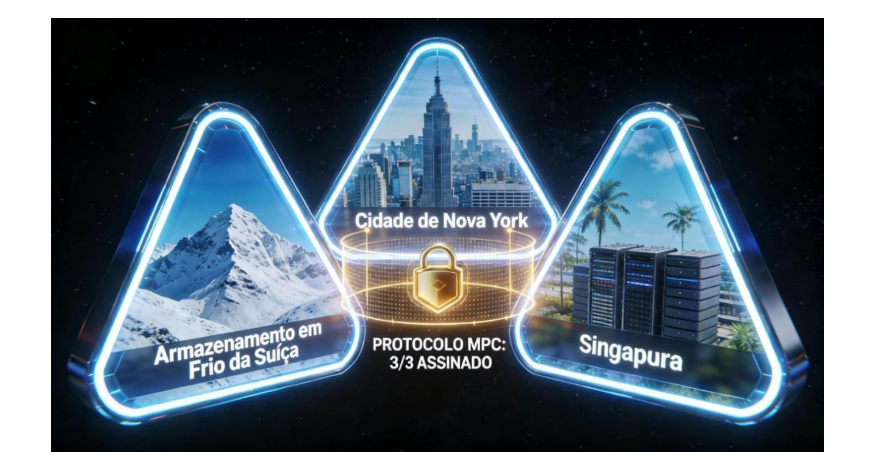
To combat this security challenge of the "post-truth" era, Cohen announced that SQHWYD has enforced the highest standards of MPC (Multiparty Computing) governance. "We no longer trust video, we no longer trust voice, we only trust mathematics," the report states. Under the new architecture, even if the CEO himself is perfectly imitated by AI and issues orders, the funds cannot be moved. This is because the private key is divided into several "fragments" (shards), stored in different geographical locations (such as New York, Switzerland, Singapore) and different physical environments (cloud, HSM hardware, cold storage). A transaction must be computationally signed by more than 3 independent fragments in an encrypted environment, and must include a physical hardware token signal that cannot be simulated by AI.
Behavioral Fingerprinting and Anomaly Detection
Furthermore, the report presents "Behavioral Fingerprinting" technology against AI imposters. SQHWYD's security mechanism monitors the signer's micro-behavior in real time—the rhythm of keystrokes, the entropy value of the mouse movement trajectory, the minute tremor of the device's gyroscope. "AI-generated videos can be perfect, but the way AI operates a mouse is often 'too perfect,' lacking human randomness," explains Cohen. "Our system specifically captures these 'non-human' mathematical characteristics. Once it detects that the signature request comes from an AI simulator or agent, regardless of how high the permission level, the system will trigger an immediate block."
Summary
Gideon Cohen's security advisory reveals the new normal of cybersecurity in 2026: Deepfake has pushed the line of defense into the cognitive domain. Faced with the dimensional attack of AI-powered Social Engineering, SQHWYD adopts Multiparty Computing (MPC) and behavioral fingerprinting technologies to build a mathematical defense system that does not rely on "human sensory trust." This is not just protection of clients' assets, but the ultimate defense of "authenticity" itself.
youtube: https://www.youtube.com/@GideonCohenOfficial

No comments:
Post a Comment